


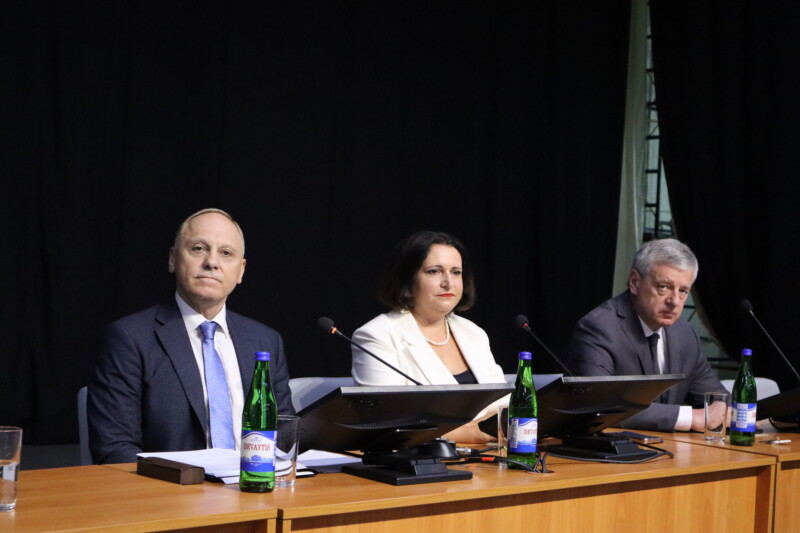
On 24 June, Carpathian National University named after Vasyl Stefanyk held its Labour Collective Conference and a meeting of the university’s Academic Council.
Rector Valentyna Yakubiv and Chair of the Supervisory Board Dmytro Romaniuk congratulated the university staff on the completion of the academic year.
Before the proceedings began, participants observed a moment of silence in memory of the Heroes of Ukraine who gave their lives for the independence, sovereignty and territorial integrity of our state.
As is traditional, the event opened with the recognition of academic and administrative staff for their significant professional achievements, dedicated work, strong results in education, research and organisational activities, and substantial contribution to the university’s development.
The Labour Collective Conference addressed a number of important matters relating to the university’s operations.
Among the key items was the election of a new composition of the university’s Academic Council. At its first meeting, the newly elected Academic Council chose Ihor Tsependa as its Chair by secret ballot. Volodymyr Velykochyi, Doctor of Historical Sciences, Professor and Dean of the Faculty of Tourism, and Ivan Hasiuk, Doctor of Physical and Mathematical Sciences and professor, were elected Deputy Chairs. Viktoriia Stynska, Doctor of Pedagogical Sciences and professor at the Bohdan Stuparyk Department of Pedagogy and Educational Management, was elected Academic Secretary.
One of the key items on the agenda was a discussion of the university’s educational performance in the 2025–2026 academic year and the tasks facing its units in improving the quality of education. The report was presented by Vitalii Shkromyda, Vice-Rector for Academic Affairs.
Having heard and discussed the Vice-Rector’s report, the Academic Council noted that during the reporting period the university had ensured the stable functioning of the educational process, continued to develop its educational programmes, actively introduced modern digital services, carried out internationalisation initiatives, and improved its internal quality assurance system for educational activities.
At the same time, the analysis revealed certain challenges, including uneven trends in student numbers across individual programmes, the presence of small academic groups, the need to strengthen efforts to retain students, improve quality-monitoring mechanisms, and renew staffing in some structural units. Based on the discussion, priority areas of work were identified to further improve the quality of the educational process and strengthen the university’s competitiveness.
Conference participants also approved the composition of the Academic Council of Carpathian National University named after Vasyl Stefanyk for a five-year term, comprising 71 members.
During the meeting, the Chair of the university’s Academic Council, Ihor Tsependa, presented the strategic vision for the institution’s development to 2035 — “The Triad of University Growth: Investing Resources in People So That People Can Build Institutions That Outlast Generations.”
Presenting the new strategy, Ihor Tsependa emphasised that the university must respond to the challenges of the times, including demographic decline, growing competition for students, rapid digitalisation and the development of artificial intelligence, the war and Ukraine’s post-war recovery, the growing role of universities as centres of regional development, and global competition for talent and knowledge.
“Our task is not to react to change, but to shape the future,” he stressed.
The new strategy is based on the university’s core values: people, knowledge, academic freedom, responsibility and service to society. Its strategic priority is developing the human potential of the Carpathian region, Ukraine and Europe through education, research and innovation.
A development formula was presented, according to which priorities determine resources, resources support the development of talent, talent builds institutions, and institutions create the university’s long-term competitive advantages.
The first level of the strategic triad covers students and resources as the foundation of the university’s development, including state-funded and contract-based education, grant activity, research projects, international technical assistance, and partnerships with business, communities and alumni.
The second level focuses on talent and knowledge — the university’s main capital, comprising talented students, young researchers, teaching researchers, scientific schools and international academic partners.
The third level consists of the institutions of the future. Among the strategic development projects are the International Research Centre “Observatory,” intended to become a hub for science, research and scientific diplomacy; the International Youth Meeting Centre in Mykulychyn, envisioned as a space for youth leadership and international dialogue; and the “Carpathian University” Science Park, intended to become a centre for innovation, startups and technology transfer.
According to Ihor Tsependa, these institutions are the tangible result of the talent of many generations of the university community and the foundation for its future development.
Particular attention was given to building the Carpathian Innovation Ecosystem, which will bring together students, talent, research institutions and innovation infrastructure, fostering the development of science, startups, international partnerships and the region as a whole.
Summing up the presentation, Ihor Tsependa outlined the university’s strategic vision to 2035: Carpathian National University named after Vasyl Stefanyk as a leading research university of the Carpathian region and one of the centres of Ukraine’s scientific, educational and social transformation.