


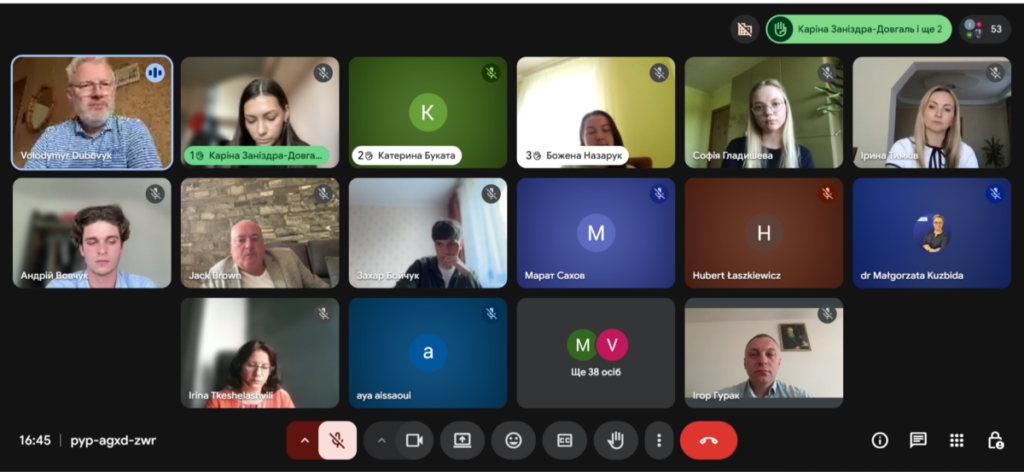
On 30 May 2026, the jubilee 30th Carpathian Youth Scientific Forum was held online on the theme “Transatlantic Relations at a Crossroads: Contemporary Relations Between Europe and the United States of America.” This year the forum brought together participants from Ukraine, Poland, Turkey, Ireland, and the USA, becoming yet another important space for international academic dialogue on contemporary transatlantic relations, security challenges, and Ukraine’s role in shaping a new architecture of European security.
The initiator and permanent head of this academic platform, which has united young researchers from Ukraine and abroad since 2013, is Ihor Hurak, Dean of the Faculty of History, Political Science and International Relations and Professor of the Department of International Relations. The event’s co-organizers were the Centre for East European Studies of the University of Warsaw (Republic of Poland), Karabük University (Turkey), the University of the National Education Commission in Kraków (Republic of Poland), and the University of Wrocław (Republic of Poland). On the part of Vasyl Stefanyk Carpathian National University, the event was organized with the involvement of the Department of International Relations, the Department of Foreign Languages and Translation, the “Young Diplomacy” Centre, and the Educational and Research Centre for Central and Eastern European Studies.
Welcoming remarks to the forum participants on behalf of the organizing universities were delivered by Ihor Hurak; Yuliia Biletska, representing Karabük University; Małgorzata Kurzyca, representing the University of the National Education Commission in Kraków; Hubert Łaszkiewicz, Deputy Director of the Centre for East European Studies of the University of Warsaw; and Liliia Turovska, Vice-Rector for Scientific-Pedagogical Work and International Activity of Carpathian National University. In their addresses, they emphasized the significance of international academic cooperation, the role of young researchers in shaping contemporary scholarly discourse, and the particular relevance of reflecting on transatlantic relations during a period of profound geopolitical transformation.
The forum panels were moderated by Iryna Tymkiv, Orest Boichuk, and Svitlana Kobuta.
Participants paid special attention to the presentations of key speakers. Professor John O’Brennan (Maynooth University, Ireland) shared his vision of the transformation of the European security system and the future of transatlantic relations, noting that Europe is currently in a phase of rebuilding and reconstructing its own defence system. The speaker devoted considerable attention to the process of strengthening European defence autonomy and the changing role of the United States in its interaction with European allies.
Professor Volodymyr Dubovyk (Center for European Policy Analysis) analysed the current state of relations between Europe and the USA, as well as the key challenges facing NATO. His presentation focused on Russian aggression against Ukraine, internal debates within the Alliance, and new challenges for the Euro-Atlantic partnership.
Alongside participants from universities in Poland and Turkey, thorough presentations were given by Nataliia Pitei and Oleh Kril, postgraduate students of the Faculty of History, Political Science and International Relations. Nataliia Pitei presented research dedicated to the key ideologues of Donald Trump’s second administration and their influence on the European policy of the 47th President of the USA. Her presentation focused on the various groups of influence surrounding Donald Trump — from economic nationalists to representatives of the technology elite — and their impact on US foreign policy direction and the prospects for interaction with the European Union.
In his presentation, Oleh Kril analysed the concept of “peace through strength” in the context of the transformation of American strategy toward Ukraine under Donald Trump’s second administration. The presentation outlined the diplomatic, economic, and military instruments of current American policy and stressed the need for Ukraine to strengthen its own self-sufficiency and deepen its integration into the European defence sector.
Particular interest among forum participants was drawn to a presentation given during the discussion by Iryna Tkeshelashvili, representing the Polish Society of European Studies in Opole and the “Europe Direct” team at the European Commission in Poland. She focused on issues of information security and countering disinformation. The speaker shared Polish experience in institutional support for media projects and emphasized the importance of personal responsibility and the development of critical thinking as components of societal resilience.
The 30th Carpathian Youth Scientific Forum once again confirmed its important role as an international platform for academic dialogue, support for young researchers, and the shared examination of key challenges in contemporary international politics.